In the last hour of summer, as the classroom fluorescents flickered to life and the first of the buses coughed its way into the parking lot, Conor Moreton wriggled out from the dark space beneath the equipment shed and began to climb.
He was alone, and that was not part of the plan. Alone, getting onto the shed meant squeezing into the narrow gap where it butted up against the gym, using the pressure between the two walls and his body to inch his way upward. It was slow going, and he always slipped at the top, scraping his forearms against the rough shingle as he pulled himself past the gutter. Much easier with two—one to boost, and the other to reach back and help the first up.
But Ashleigh was not coming, could not possibly be coming, was at the very least grounded and most likely suspended. Conor knew this—
(Had to know it, on some level, given how skillfully he managed to not-think it, the words somehow failing to form even as his thoughts swirled all around them, like a blind man weaving his way through the furniture in his living room.)
—yet still he’d waited for the other boy, shivering in the dark—waited as the night turned grey and the teachers trickled in, as hope gave way to outright denial and even denial wore thin.
Then he’d waited longer.
It was fear, of course.
(Just fear, he would have said, had anyone asked.)
But this fear was different. Was wilder than the usual sort, more primal—kin to the dread that still seized him sometimes, when his parents made him take the garbage can down the long, dark driveway after sundown. It was Guyler’s blood staining the sidewalk the night before, and the way his pupils had been different sizes as the paramedics loaded him onto the stretcher. It was the empty cheerfulness of Ashleigh’s voicemail, the awful silence as Conor texted him, messaged him, threw acorns at his bedroom window. It was the horrifying realization that the rules had changed—had maybe never really been there in the first place—that the lines on the road were just paint, really, and there was nothing, nothing, nothing at all between him and the sort of things you heard about on the news.
Ten minutes.
Guyler and Ashleigh had been alone together for ten minutes. Not even, probably, when you factored out the time it would’ve taken Ashleigh to come down from the roof. Maybe only five. Maybe not even.
In five minutes, the two of them had ended the world.
And as thoughts like that came and kept coming, it became more and more important that Conor wait for Ashleigh—Ashleigh, who was brave, who was invincible, who would laugh and say lighten up, man, you act like we’ve never been in a little trouble before. He was on his way, had to be, just a few more minutes and he’d round the corner, a spring in his step and an easy excuse on his lips. And they would do the climb together, and it would be fine, everything would be fine, Conor just had to give him a little more time—
In the end, it was the sound of car doors slamming in the front circle that got him moving, a sound that said if he didn’t start right now, he’d never make it back down before first bell.
With one final heave, he dragged himself past the gutter and out onto the shed roof, staying low, letting the shallow peak hide him from the windows of the buildings opposite. Rolling over onto his back, he waited for his breathing to slow, picking dirt and grit out of his scabs as he stared unseeing up into the heavy September sky.
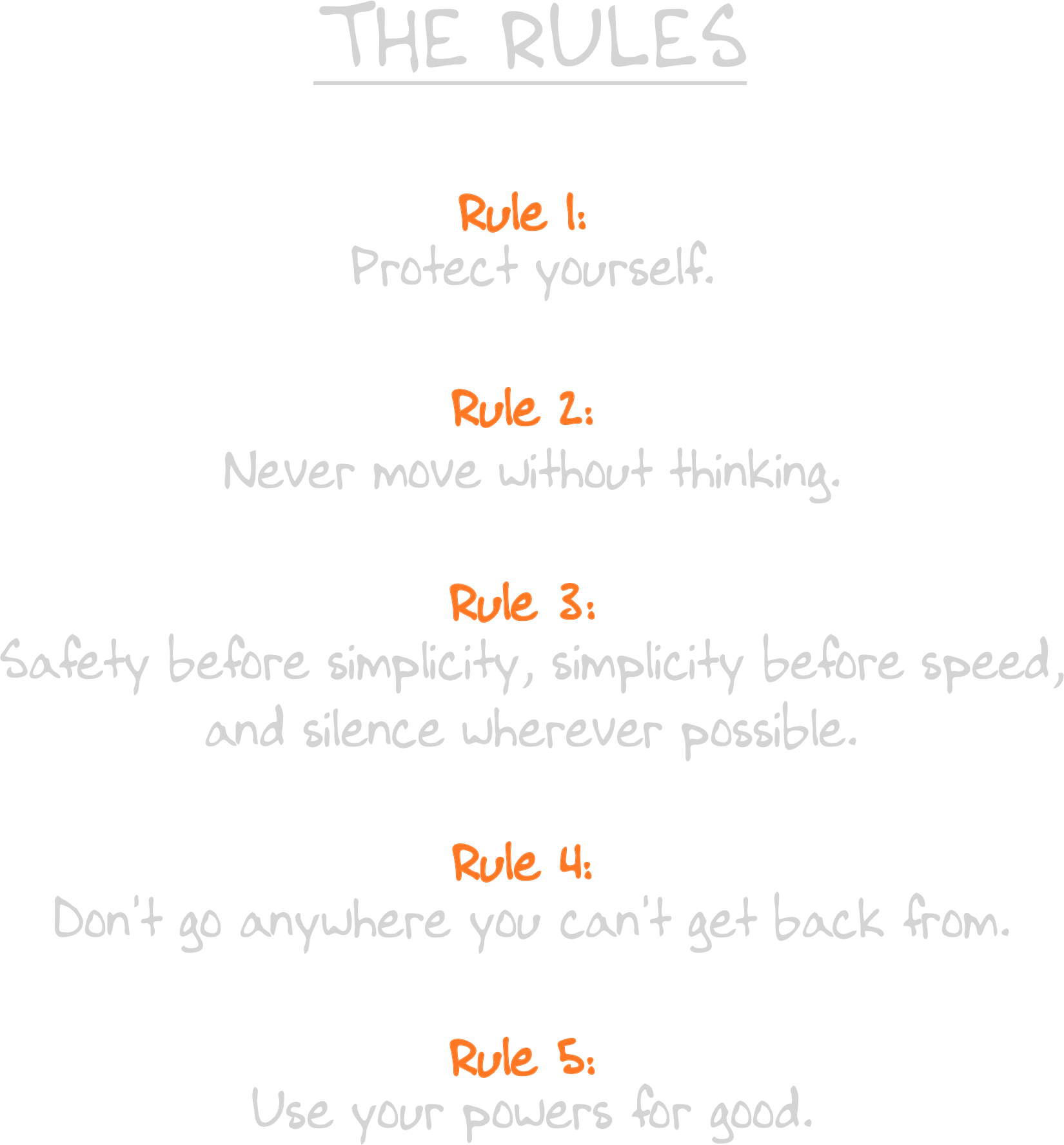
Rule number one, he thought quietly. Protect yourself.
(Although thought was not quite the right word. The thought happened. Conor didn’t think it, exactly—not in the sense that he brought the words forward on purpose. They were simply there, as if he’d spotted them by chance in the swirling clouds above.)
The next checkpoint was the aluminum breezeway awning, five feet away and two feet higher up, covering the sidewalk that ran between the gym and the front office. It was an unpleasant jump even at the best of times—the slope of the roof made for an awkward takeoff, and there was something spooky about the way the awning just hung in space, with no wall for him to kick his feet against if he came up short.
But that was a fear Conor knew well, and knew his way through. And he needed the awning to get to the electives building, and he needed the electives building to get to the tree, and he needed the tree to get to the pipe and the pipe to get to the roof. And he needed the roof because—
(His thoughts stuttered.)
He just…needed the roof, that was all.
He rolled back over onto hands and toes, lizard-fashion, listening.
Rule two: never move without thinking.
There were no sounds in the quad below—not yet, not this early. Slowly, slowly, he pushed himself upward, peering past the ridge of shingle, eyes alert for any sign of movement in the windows facing the grassy square.
All clear.
Silently, he popped to his feet, stepped to the edge, and leaped across the gap, wincing as the metal of the awning flexed and groaned under his weight. It was wet, last night’s rain still spotting every surface, and he picked his way with care, stepping from brace to brace as he made his way over to the electives building. Pressing up against the brick, he stretched as high as he could and then jumped, his fingers just barely able to catch the edge of the roof proper.
Like most of the buildings at East Binder Secondary School, this one was covered in a thin layer of gravel, dotted here and there with air conditioning units and surrounded by a raised metal edge exactly four inches wide—
Conor’s lip twisted.
Right.
A wet metal edge.
He wiped his hands on his sweatshirt, looking down at the dull, corrugated surface.
Rule three. Safety before simplicity, simplicity before speed, and silence wherever possible.
The edge would be slippery. But that didn’t necessarily make it dangerous—not if he stayed focused, stayed locked in, kept his feet under him and the rest of his body under control. And the alternative was to crunch his way through the gravel, directly over the classrooms where the teachers were this very minute preparing for the day…
He let out a breath.
Arms out for balance, he walked carefully along the edge, bracing himself for a shout from below, willing himself not to twitch or stumble. But no one saw him, and soon enough, he had rounded the corner to the long side of the building, where the magnolia stood.
It was a gnarled and magnificent tree, far older than the school around it, rising proudly from the grass between the electives building and the auditorium beyond. Branches poured down from its trunk like a jungle waterfall, trimmed back too high to be reached from the ground, but spreading carelessly over the rooftop where Conor now stood. Slipping in among them, he leaned out over empty space, grabbing hold of a wrist-thick limb at the edge of his reach and swinging into the foliage.
Slowly, methodically, he picked his way across the tree. Soon, he arrived at a junction—almost a fork in the trunk itself—where one massive branch split away from the rest and reached out to brush, fingerlike, against the auditorium wall.
Rule four. Don’t go anywhere you can’t get back from.
The first time—ages ago, at the beginning of summer—it had taken all of Conor’s courage to creep out to the very edge, where the sagging, overloaded limb let him rest his hands against the bricks, a full twenty feet above the ground. But that was where the prize lay, the key to the puzzle: a sturdy, three-inch metal pipe emerging mysteriously from the otherwise empty patch of wall and stretching all the way to the roof.
No way, Ashleigh had said, when Conor first suggested it. Not in a million years.
But there was no other way, as Ashleigh himself had reluctantly admitted. And so (after a week) no way became fine—you first.
Taking a deep breath, Conor readied himself, his right hand curled around the pipe, his left still braced against the wall, his body bobbing slowly up and down as the breeze whispered past the shaky branch. His eyes fluttered shut, and for the briefest of moments, a thousand objections swelled into his mind—that he was too tired, too shaky, that the roof was too far, the pipe too wet, that there was no one around to help him if he fell and he would be late and he would be caught and he could die, actually, he’d gotten used to doing this sort of thing but yesterday—
(A memory of flashing lights.)
Conor opened his eyes.
No.
Not right now.
With a swift, sure motion, he sprang forward, leaving the tree behind, planting both feet against the wall and pulling himself in to hug the pipe as the branch tore upward past him. A smattering of leaves and twigs rustled their way toward the ground, dusting his hair, his shoulders. He waited until all was still, shifting back and forth, testing the grip of his sneakers against the bricks as he leaned back, rappel-fashion.
And then he climbed.
Hand over hand, step by step, up past the leafy canopy and out into the open, using the pipe like a rope, each breath coming in animal rhythm with the scrape of his shoes and the beat of his heart. Once, he paused, shaking out the tightness in each arm and wiping the sweat from his brow, but otherwise he moved like a machine, his thoughts quiet, every action efficient and precise. Scarcely twenty seconds passed before his fingers found the sudden emptiness that marked the end of the pipe, and then he was there, chest heaving and face flushed, swaying like a boxer at the summit of the school.
Okay, he thought, as his heartbeat slowed once more, his fingers gradually coming unclenched.
Okay.
There were whispers of conversation below, drifting up from the front courtyard where the earlybirds were gathering. He could hear voices but not words, a soft, tumbling chorus that came and went as the wind changed direction. There was happiness there, and excitement—a touch of nervousness and an air of expectation.
(Conor felt none of it. The sounds, the feelings—they belonged to the old world, the gone world, the one where getting a locker all his own was the best thing since giving up training wheels, where he’d spent the last Saturday of summer fretting over whether there would be a quiz on the reading he’d so blithely blown off.)
Shoobies anyway, whispered Ashleigh’s voice in his head, and for a moment Conor squeezed his eyes shut again, feeling the other boy’s absence, the hole in the air where his best friend should be.
Rule five: use your powers for good.
Conor opened his eyes again.
Ahead, the world was a patchwork of grey, the rooftop shouldering a sky of slate and gunmetal, slowly turning silver as the sun backlit the clouds. There was the usual scattering of squat, steel structures—fans and ventilation shafts, a trapdoor set in weatherworn concrete. A pair of long, thin furrows slashed through the gravel like tire tracks, twin paths where the stones had been swept aside, revealing the black shingle underneath.
Moving on autopilot, Conor took the left one, heading for a place in the center where the two paths widened, crossed, bleeding into one another to form a clear space large enough for two to sit in.
There.
He crouched, reaching.
It was a twist of paper, half an inch long and narrower than a pencil, with a few loose, blackened flakes still poking out of one burnt end. They fell as he lifted it, vanishing into the wind.
It isn’t dangerous, Ashleigh had said. Not if you do it just once.
He’d rolled it right there in front of Conor, pulling the musty flakes from the bag they’d been haunting since June. Conor had objected, of course. Ashleigh was talking about doing drugs—about doing drugs on a rooftop—a school rooftop—about stealing drugs from god knows who—wasn’t this the literal exact opposite of why they were there? Why they’d spent nearly the whole summer baking in the sun, just watching and waiting?
He’d stood up, half expecting the other boy to stop him—had stalked back to the pipe, bracing himself the whole way for Ashleigh’s laughter, his smooth talk, his cutting disdain. He’d made it all the way back to the edge before turning back for one last look—
Ashleigh was just sitting there, frozen, hand still extended.
I just thought, the other boy had said. And in that moment, he had looked so fragile, so breakable in a way that Conor had never seen before, and Conor had almost kept going, almost run from that look that was so unnerving and alien on his best friend’s face.
But he hadn’t. He hadn’t been able to. And that had been the beginning, and the end had been blood and sirens and angry grownups, a thousand questions and only Conor to answer them, and Conor didn’t know—
With a sudden, violent motion, he shredded the tiny roll, scattering the bits of paper, kicking the gravel around to cover what the wind wouldn’t take. Reanimated, he turned, striding over to the nearest air conditioning unit, where he tugged at the loose panel until it came away in his hands. Reaching into the dark space inside, he groped around until his fingers touched plastic, and pulled out a bag.
(The bag.)
Rule number one: protect yourself.
His first thought had been to destroy it. Just upend it at the edge of the roof, watch the musty flakes disappear into the wind. But—
(It happened this way sometimes, his thoughts going twisty, pressing forward until they came up against a wall and then turning and pressing forward again.)
But Guyler had known they had been on the roof.
Would have told the teachers, who would maybe come searching.
And if they found something, everyone would hear about it, everyone would know.
And then whoever owned the damn thing would come looking.
It didn’t quite make sense. Didn’t quite hold together. But Conor felt, in his guts, that he couldn’t just leave it, couldn’t destroy it—that there was some narrow, convoluted path between disasters, and it started with getting the bag out of there, before anyone else could find it.
(Rule two was never move without thinking.)
Taking a breath, he tucked it into his belt, pulled his sweatshirt down to cover it, began to turn back toward the pipe—
(Again there was the blind-man feeling, the anti-thought, a sense that some part of him was trying to think something and the rest of him was saying no.)
It’s time to go, he thought to himself, the words almost pleading.
But there was only one direction his body would allow—away from the pipe, in the other direction—toward the far side of the roof, where the two paths ran straight and true right to the very edge, like twin rivers pouring over a cliff.
Don’t, he thought. Do not.
But his legs were already in motion, his feet falling once more into the left of the two paths.
(His path.)
(Because part of rule three was silence wherever possible.)
As Conor walked, some part of him began counting backwards, working his way down from thirty, his pulse quickening with each step. At ten, the horizon finally broke, the clouds shrinking skyward as the gymnasium below came into view once more. At five to go he faltered, and at one he stopped completely, heart pounding, just inches shy of the edge.
Of the gap.
Binder’s Gap.
It was a name for nothingness, a label strung spiderlike in the space between two somewheres. Directly in front of him was the gym, its roof seventeen feet away and twelve feet further down. In between was only air—air, and a forty-eight foot drop to the sidewalk below. Conor knew the numbers by heart—had traced them, paced them, measured them over and over again until they carved themselves into his mind in the form of an inescapable truth:
It takes just under two seconds for an object to fall forty-eight feet.
And there, on the other side—faint enough that he might have missed it, but clearer and clearer the longer he looked—
A pair of shallow scars, a hint of black shingle, a slight interruption in the otherwise smooth gravel, just a couple of feet in from the edge and perfectly in line with the path that stretched backward from where Conor now stood.
That, he thought.
(Quietly, tentatively, as if giving himself time to prepare, to brace.)
That was where he had landed.
For long seconds, he couldn’t quite process it, the impossible hugeness of it. He felt pressure against his toes, looked down to find that his feet were pressed against the raised metal border.
Half-step forward, half-step back.
(Rule four: don’t go anywhere you can’t get back from.)
Conor took a half-step back.
I really did it, he thought.
He squeezed his hands, feeling the bruises in his palms, the aftermath of the bone-rattling shock when he’d landed, when he’d rolled. It wasn’t that he had doubted, exactly. It was just that the memory hadn’t quite fit—had refused to settle into the space he’d carved out for it, through the long summer of practice and planning.
Maybe because you always imagined it being both of us, whispered Ashleigh’s voice.
They had laughed, yesterday, as they’d broken forward—laughed out loud, the thick, wet wind of the coming storm tearing at their jackets, the air itself seeming to crackle with possibility. They’d been neck-and-neck, their feet pounding on the rooftop, so loud, so reckless, and Conor had pulled ahead, exhilarated, had been running as hard as he could, for once he was beating Ashleigh, he was winning—
Then the leap—the flight—the landing—and the realization, as he came to his feet, that something was wrong. Conor had turned, and every crunch in the gravel had come from his own motion—there were no other sounds on the rooftop—he was alone, he was alone—the almost heart-stopping terror as everything else fell away and there was only the thought—that Ashleigh hadn’t made it, that he was down below on the grass.
He had raced back to the lip, had almost thrown himself over it in his panic, and when he’d seen that the ground below was empty—
Relief.
“Ash!” he had cried, looking back up to the auditorium roof—
(Thinking that the other boy was hiding, was embarrassed—that he had chickened out but could be razzed into trying again, especially now that Conor could tell him it was easy, as easy as standing on two feet, why on Earth had they both been so afraid, waited so long?)
—but there had been no answer.
No answer, and as the seconds stretched out, as he called out a second time, and then a third, Conor had felt the dread rising once more, some sixth sense whispering, whispering. It had taken him forever to figure out a way down from the gym—
(Why had they not thought of that in advance, and planned a route?)
—and by the time he finally touched ground and ran around to the magnolia, it was too late. Guyler was down, Ashleigh was running, and for the next hour everything was chaos and confusion until finally he’d broken down in tears and his parents had taken him home and put him into bed. He had fallen asleep, must have slept, because he snapped fully awake at five in the morning with one thought crystal clear in his head: that he had to move the bag now, before anyone else could get to it.
And now he was here. He had it, mission accomplished. And—
—and—
—and—
And what?
Conor didn’t know.
Didn’t know anything. Had no idea where Guyler had come from, why the other boy had been there at all. Had no clue what had happened between them, that had ended with Guyler bleeding and unconscious on the sidewalk. Had no idea what would happen next, or what to do next—had had only this one lone next action, and was now out of cards to play. Whatever magic had filled the rooftop yesterday was fading, fading, draining away—without being able to put it into words, Conor had the profound sense that these were the very last moments of—
Of—
Of something. Something sane and familiar, something that had been dealt its deathblow the night before and was now breathing its very last breath.
Rule five: use your powers for—
He dashed the thought, scattering its pieces, and nothing took its place.
Reaching down, Conor picked up a stone, tossed it gently, underhanded, out into space. It soared in a perfect arc, slicing through the wind, vanishing into the gravel on the other roof with only the smallest of sounds.
It had all seemed so important, yesterday. So necessary, so monumental, a feat to top everything else he’d ever done.
But what had changed, really? What did it matter? A few bruises on his hands, a few stones there when they would have been here. One brief and shining memory rendered meaningless by what had come after.
He picked up a second stone, let this one slip from his fingers and drop straight down, counting silently in his head—one hippopotamus, two hippopo—
The stone struck the sidewalk.
Hey, Dead Poets Society, whispered the Ashleigh on his shoulder. I think you might be running out of time.
Give me a minute.
For what?
(He tried to think of an answer. He really did. But that was the problem—there wasn’t one, not in any place his thoughts could reach all by themselves. It was Ashleigh who knew, Ashleigh who’d been there, who had all the whats and the whys.)
(And Ashleigh was somewhere else.)
Conor stared across the gap and into yesterday.
He took a breath—held it—let it out.
And then he turned and walked back to the pipe, kicking the gravel back into place as he went, leaving no sign that he or anyone else had ever been there.